India's Position in the Global Mustard Seed Market
Mustard is not a secondary oilseed. After soybeans and palm oil, it is the world's third-largest source of vegetable oil. India sits at the center of that supply chain — ranked third globally in rapeseed-mustard production behind Canada and China, accounting for approximately 11% of total world output.
According to the latest government data, India's rapeseed and mustard production in 2024-25 stood at 126.06 lakh tonnes (12.6 million MT), harvested across 86.29 lakh hectares at an average yield of 1,461 kg per hectare. Rajasthan alone contributes over 40% of national production, with Haryana, Madhya Pradesh, Uttar Pradesh, and West Bengal as the other primary growing states.
India's oilseed exports reached USD 1.34 billion in FY25, with mustard oil and meal constituting a significant portion. During the early months of FY26 (April–June 2025), total oilseed exports already reached USD 306 million — indicating sustained export momentum heading into the full fiscal year.
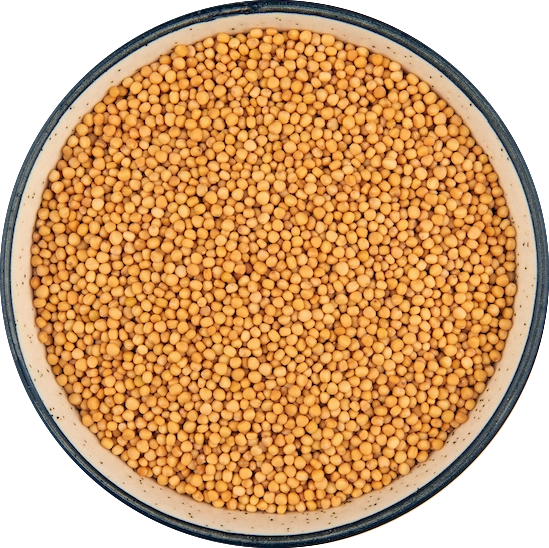
Yellow vs. Brown Mustard: Two Varieties, Two Completely Different Markets
The single most important thing a global buyer needs to understand about mustard seeds is that yellow and brown are not interchangeable commodities. They serve different markets, command different prices, and have entirely different end-use applications.
Yellow Mustard (Sinapis alba / Brassica hirta): Mild, light pungency. Oil content 28–32%. Primary markets: North America and foodservice. Key applications: table mustard, mayo, dressings, sauces, emulsifier in processed meats. FOB $680–780/MT. Holds 51% of global mustard seed market share.
Brown Mustard (Brassica juncea / Indian Mustard): Sharp, intense, pungent heat. Oil content 38–42%. Primary markets: Europe, Asia, Middle East. Key applications: Dijon/specialty mustards, cooking oil, spice blends, Kachi Ghani cold-pressed oil. FOB $580–660/MT. Holds 29% of global mustard seed market share.
Yellow mustard commands a premium of $80–120/MT over Indian brown mustard — reflecting end-market differentiation, not a quality differential. North American condiment manufacturers specifically require yellow mustard for its milder flavor profile and superior emulsification properties. European specialty mustard producers — particularly those making Dijon and French-style condiments — source brown mustard for the sharp, complex heat it delivers.
What Is Happening in the Market Right Now — April 2026
1. The 2025-26 Harvest Was Hit by Erratic February Heat
Erratic heat in February 2026 damaged mustard pods across key growing districts during their critical development phase. This reduced total output and tightened the domestic supply chain. As a result, the Indian government raised the MSP to Rs. 6,200 per quintal for the Rabi 2026 marketing season — and Rajasthan's RAJFED began state procurement of 1.37 MMT from March 25, 2026. State buying at this scale removes cheap supply from private crushers and sets a hard price floor across northern markets.
2. Russian and Belarusian Supply Disruption Is Creating Opportunity
The EU's 50% additional tariff on Russian and Belarusian agricultural products (in force since July 2025 under Regulation EU 2025/1227) is pushing European food manufacturers and spice processors to diversify origins — with India as one of the primary alternatives. This structural shift is most pronounced in the brown mustard segment, where Indian Brassica juncea directly substitutes for Eastern European seed used in Dijon-style and specialty condiment production across Germany, France, and the UK.
3. The Global Mustard Market Is Expanding — With Non-GMO Demand Accelerating
The overall mustard market is estimated at USD 10.53 billion in 2026, growing to USD 13.55 billion by 2031 at a 5.18% CAGR. Demand for organic and non-GMO mustard seed has risen 56% since 2020, with 460,000 MT now cultivated under organic-certified farming practices globally. Indian mustard's non-GMO status is increasingly a competitive advantage — the mustard seeds segment alone is valued at USD 3,015 million in 2025, with India commanding a USD 903 million share — the single largest country position at 29.9%.
Indian mustard seed wholesale: Rs. 57–69/kg (~$0.67–0.80/kg) · FOB brown mustard: $580–660/MT · FOB yellow mustard: $680–780/MT · Average Indian mustard export price 2024: $815/MT (+5.9% YoY) · Mustard oil wholesale India (April 2026): $1.76–2.09/kg · MSP Rabi 2026: Rs. 6,200/quintal
Key Export Markets for Indian Mustard Seeds
India's mustard seed exports span 70+ countries, with distinct geographic demand patterns by variety and end use:- Nepal: Dominant destination by volume — 61% of total seed exports. Regional trade and domestic oil pressing industries drive consistent demand.
- United States: Second-largest by value. Yellow mustard procurement for North American condiment manufacturers and specialty food processors.
- Sri Lanka: Condiment and cooking applications with a growing spice processing sector.
- Middle East (UAE, Saudi Arabia): Strong demand for mustard oil and whole seeds — India exported 46,000+ shipments of mustard oil to these markets in 2023-24.
- Europe (Germany, UK, France): Brown mustard for Dijon-style condiments and specialty food production, growing under the EU tariff shift away from Russian-origin seed.
- Australia and Canada: Re-export and specialty food processing, with demand for certified organic and non-GMO formats.
What Importers Should Verify Before the Next Shipment
The mustard seed supply chain carries specific risks distinct from other oilseeds. Verify the following before contracting:- Variety verification: Confirm which Brassica species your supplier is exporting — Brassica juncea (brown/Indian) or Sinapis alba (yellow). Mixing these in error creates reformulation problems downstream.
- Oil content certification: Brown mustard should carry 38–42% oil content for industrial buyers. Request lab certificates confirming oil percentage per batch — not just purity specifications.
- FSSAI compliance: Indian mustard oil exports require a mandatory negative test for argemone oil adulteration. Buyers receiving mustard oil must verify this certification is present on every shipment.
- Moisture and purity standards: Whole seed exports should be graded to moisture below 8% and purity above 98%.
- Organic / non-GMO certification: Verify the specific certification body and scope — not all Indian exporters holding one certification hold both.
- MSP and pricing floor awareness: With MSP at Rs. 6,200/quintal and RAJFED procurement active through Q2 2026, spot prices will remain firm. Buyers expecting 2024-level discounts should revisit their cost models.
February 2026 heat event reduced 2025-26 mustard crop output below initial projections. RAJFED state procurement of 1.37 MMT creates a firm domestic price floor. Spot availability is tighter than the prior season. Indian mustard oil wholesale prices rose from $1.55/kg in 2024 to $1.77/kg average in 2026 — a 14% increase over two years. Forward contracting for Q3–Q4 2026 needs is advisable for volume buyers.
India's Mustard Oil Export: The Value-Added Dimension
Beyond whole seeds, India's mustard oil export market represents a significant and growing revenue stream. India produced a record 12 million MT of mustard oil in 2023-24, exporting 4.88 million MT worth Rs. 15,370 crore in that year.
Mustard oil exports go primarily to Australia, the UAE, and Canada — with growing flows to Bangladesh, the UK, and European specialty food markets. The oil is exported in two primary grades: Grade I (Kachi Ghani / cold-pressed), which commands a premium in health-conscious markets, and Grade II (solvent-extracted / refined) for industrial food processing applications.
Mustard oil currently holds 43.02% of the overall mustard market by application, supported by the global shift toward natural, cold-pressed cooking oils and the documented health benefits of the glucosinolate and omega-3 fatty acid profile in mustard oil.