India's Red Lentil Export Policy: The 2026 Free-Market Era
The global red lentil landscape looks very different today than it did last year. India's definitive pivot toward trade liberalization in FY 2025–26 — characterized by the removal of long-standing masoor export restrictions — has reopened a massive supply channel. For international procurement managers, this isn't just a policy update; it's a fundamental change in 2026 sourcing strategies.
Red lentil export from India is now operating under its most open policy environment in nearly four years. Throughout FY 2025–26, the Indian government maintained a 0% basic customs duty on masoor imports and, crucially, completely removed the restrictive export caps instituted in 2022. While those prior policies successfully insulated the domestic market from global food inflation, they effectively shut Indian suppliers out of key bilateral trades. Today, that door is wide open.
This liberalization is supported by strong fundamentals. India produces between 1.5–2 million metric tons of masoor annually, with Madhya Pradesh, Uttar Pradesh, and Bihar supplying over 80% of national output. Under this updated 2026 policy, India's export volume for FY 2025–26 is estimated at a substantial 450,000–600,000 MT. The core challenge for buyers in 2026 isn't finding availability; it is selecting the correct grade and validating supplier quality.
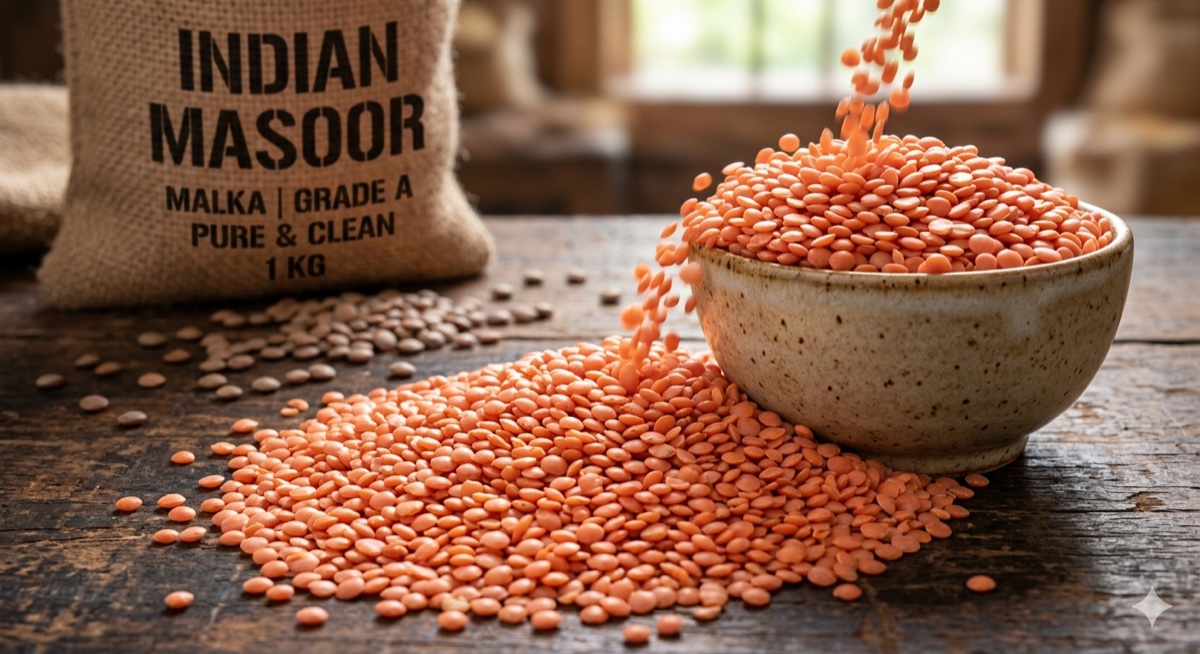
Deciphering the Indian Market: Grades, Pricing, and the Malka Premium
Indian red lentil suppliers operate across three primary commercial grades. Understanding the distinctions is essential for price benchmarking and market fit.
1. Machine-Cleaned Bold Whole (4mm+)
The premium tier. Uniform salmon-pink to red colour, minimal splits, and superior bold sizing.
- Target Markets: High-end retail (UK/EU), supermarket chains in the Gulf, and Egyptian food service.
- FOB Pricing: Upper end of the $550–$680/MT range for whole lentils.
2. Regular Whole (3.5–4mm)
The high-volume workhorse grade of the Bangladesh and Sri Lanka trade channels. Large-scale Bangladeshi importers dealing in vessel loads operate almost exclusively in this category. Specifications: moisture <12%, admixture strictly <1%.
3. Split Masoor Dal (Malka)
Processed, dehulled, split lentils ready for retail packaging or industrial food manufacturing. This deep red product commands the highest price realisation.
- FOB Pricing: $620–$720/MT.
- Growing Demand: Food-tech companies formulating lentil pasta or meat analogues now prioritise high protein documentation (25–26% dry basis) as a standard contract requirement.
The Quality Mandate: Compliance in 2026
For buyers in the EU, UK, and USA, compliance is non-negotiable. Red lentils destined for these markets must undergo:
- Heavy Metal Screening: EU Regulation 488/2014 limits for Cadmium (Cd) and Lead (Pb).
- Mycotoxin Testing: Aflatoxin B1 and OTA within EU Commission Regulation 1881/2006 limits.
- Pesticide Analysis: EU MRL compliance panel — minimum 250 active compounds via GC/MS/MS and LC/MS/MS from a NABL-accredited laboratory.
Procurement teams must demand NABL-accredited laboratory certificates from exporters before finalising contracts. Furthermore, the booming plant-based protein trend is driving new demand from food-tech companies formulating lentil pasta or meat analogues. These buyers prioritise high protein content documentation (25–26% on a dry basis) as a standard requirement over traditional dal specifications.
India's return to global masoor trade introduces a quality risk: after three years of restricted export, portions of the Indian processing infrastructure suffered from reduced investment. When qualifying an Indian red lentil supplier in 2026, anchor your audit on processing infrastructure — verify colour sorters, gravity separators, and dedicated plant ownership, rather than sourcing from aggregators.
To avoid painful destination claims, European buyers re-packaging lentils should specify moisture below 12% and admixture below 0.5% in the final contract. Simply agreeing to "Standard Export Standards" often allows up to 1% admixture, which doesn't meet tight EU retail requirements. Always require an SGS or Bureau Veritas pre-shipment inspection certificate on every shipment.
Market Outlook and Strategic Buyer Sourcing for 2026–27
India's return to global masoor trade has created immediate competitive opportunities, particularly for buyers in Bangladesh, Sri Lanka, Egypt, the UAE, and the UK diaspora market — all of whom now have access to competitively priced Indian origin at a time when Canadian origin faces high freight costs and volatile transit routing.
High-value demand in the EU and UK diaspora markets creates pricing power for processors who can provide clean, well-documented lots. Documentation rigor and certified organic availability are the secondary tier differentiators that separate specialist exporters from commodity aggregators.
Looking ahead, Indian production remains bound by monsoon variability. For buyers sourcing above 100 MT annually, we recommend moving away from spot purchasing and toward annual contracts with quarterly delivery schedules to manage price volatility and secure allocation before Canadian origin competition intensifies heading into Q3–Q4 2026.
Frequently Asked Questions
What is the current export policy for red lentils (masoor dal) from India in 2026?
India is operating under its most open masoor export policy in nearly four years. The government has maintained 0% basic customs duty on masoor imports and completely removed the export caps that were in place since 2022. Exports are unrestricted, with estimated FY 2025–26 export volumes of 450,000–600,000 MT — making India a viable and competitive alternative to Canadian origin for key markets including Bangladesh, Sri Lanka, Egypt, UAE, and the UK.
What is the FOB price of Indian masoor dal (split red lentils) in 2026?
Split Masoor Dal (Malka) FOB prices are estimated at $620–$720/MT for 2026. Machine-cleaned Bold Whole (4mm+) trades at the upper end of $550–$680/MT. Regular Whole (3.5–4mm) — the workhorse Bangladesh/Sri Lanka grade — is at the lower end of the whole lentil range. Organic-certified masoor commands a 20–30% premium on all grades.
What are the three main grades of Indian red lentils for export?
Three primary commercial grades: (1) Machine-Cleaned Bold Whole (4mm+) — premium tier for UK/EU retail and Gulf supermarkets; (2) Regular Whole (3.5–4mm) — high-volume grade for Bangladesh and Sri Lanka vessel-load trade; (3) Split Masoor Dal (Malka) — dehulled, deep red, commanding the highest price at $620–$720/MT, with growing demand from food-tech companies requiring 25–26% protein documentation.
What compliance tests are required for Indian red lentil exports to the EU?
EU-bound red lentil shipments require: heavy metal screening per Regulation 488/2014 (Cadmium and Lead limits); mycotoxin testing per Regulation 1881/2006; and a minimum 250-compound pesticide MRL panel via GC/MS/MS and LC/MS/MS from a NABL-accredited lab. European buyers re-packaging lentils should also specify moisture below 12% and admixture below 0.5% — stricter than standard export specs — and require SGS or Bureau Veritas pre-shipment inspection certificates.
How does India's masoor compare to Canadian red lentils in 2026?
Canadian origin remains the global benchmark for red lentils, but in 2026 it faces elevated freight costs and volatile transit routing. Indian masoor is now freely exportable with 0% duty and competitive FOB pricing. The key differentiator is processing infrastructure — buyers should qualify Indian suppliers on colour sorters, gravity separators, and dedicated plant ownership to ensure export-grade consistency comparable to Canadian standard.