Shatavari: The Second-Wave Adaptogen Redefining Women's Wellness in 2026
Ashwagandha has held the crown for long enough. In 2026, the "second wave" adaptogen market is being defined by Indian Asparagus — Shatavari (Asparagus racemosus). While Ashwagandha dominates the cortisol-and-stress narrative, Shatavari has found its home in the high-growth sectors of hormone balance, lactation support, and female reproductive health.
With the global adaptogens market hitting $14.5 billion, procurement managers in the US and EU are moving fast to secure 2026 allocations. But here's the reality: sourcing Indian Asparagus is a far more technical game than sourcing Ashwagandha. The quality thresholds, regulatory nuances, and supply chain risks demand a specialist approach.
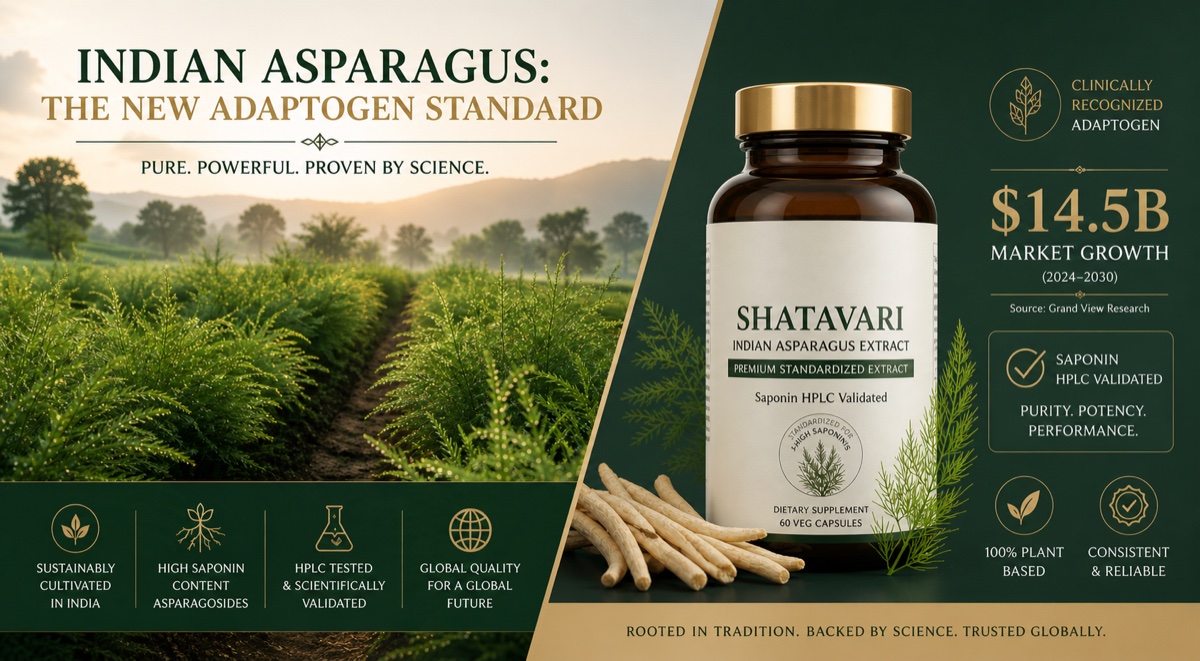
The 2026 Quality Threshold: UV vs. HPLC — Why It Matters
If your supplier is only quoting saponin content via UV-Vis, you are likely overpaying for "matrix interference." For B2B buyers serving the premium US or EU markets, HPLC-validated saponin content — specifically targeting Shatavarin I–IV — is the only way to guarantee dose-response efficacy and defend label claims under regulatory scrutiny.
2026 Form and Pricing Reference
| Form | Spec Benchmark | FOB Price Range (2026) |
|---|---|---|
| Dried Root | <10% Moisture, Pesticide-Free | $1,200–$2,200/MT |
| Root Powder | Min 5% Saponins (UV) | $2,500–$4,000/MT |
| Standardized Extract | 15–30% Saponins (HPLC) | $12,000–$25,000/MT |
The Organic Gap: Expect a 35–40% premium for USDA Organic certified material. In the current 2026 retail landscape, non-organic Shatavari is increasingly relegated to "value" tiers; organic is the entry-point for the premium women's wellness sector.
Sourcing Strategy: Cultivated vs. Wild-Harvested
The "wild-harvested" label used to be a marketing win. In 2026, it is a supply chain risk. Over-harvesting in regions like Madhya Pradesh and Rajasthan has made wild supply inconsistent in both volume and quality.
Why Radiance recommends cultivated-origin only:
- Traceability: Full farm-to-lab documentation required for EU Biodiversity compliance — wild-harvest lots cannot provide this chain of custody.
- Heavy Metal Control: Cultivated soil allows for better management of lead and cadmium levels — the #1 cause of US DSHEA compliance failure for Indian botanical shipments. ICP-MS panel required as standard.
- Price Stability: Cultivated crops are less susceptible to the wild-harvest "spot price" spikes seen in early 2025, giving buyers predictable contract economics.
For US Buyers: Shatavari remains DSHEA-compliant. Ensure your ICP-MS heavy metals panel is current — lead contamination is the most common compliance failure for Indian botanical shipments. For EU Buyers: Navigate Novel Food status carefully. Most trade currently relies on EU Regulation 1925/2006 (Food Supplements) with documented historical use. Confirm with your national authority before notifying products. Documentation of traditional use in EU markets is essential for compliant market entry.
Frequently Asked Questions
What is the FOB price of Shatavari extract from India in 2026?
2026 estimated FOB prices: Dried root (moisture <10%, pesticide-free) at $1,200–$2,200/MT; Root powder (min 5% saponins UV) at $2,500–$4,000/MT; Standardized extract (15–30% saponins HPLC-validated) at $12,000–$25,000/MT. USDA Organic certified material commands a 35–40% premium across all forms. Always specify the saponin validation method (HPLC, not UV) and target Shatavarin I–IV content in your purchase contract.
Why is HPLC saponin testing more reliable than UV-Vis for Shatavari?
UV-Vis spectrophotometry measures total saponin content but cannot differentiate between the active Shatavarin I–IV compounds and non-active matrix compounds, leading to inflated purity claims — a phenomenon known as matrix interference. HPLC (High-Performance Liquid Chromatography) isolates and quantifies individual saponin compounds, giving buyers an accurate dose-response guarantee for finished product formulations. For any premium US or EU supplement application, HPLC-validated COAs are non-negotiable.
Why should buyers avoid wild-harvested Shatavari in 2026?
Over-harvesting in Madhya Pradesh and Rajasthan has made wild Shatavari supply inconsistent in both volume and quality. Wild-harvest lots also cannot provide the farm-to-lab traceability documentation now required for EU Biodiversity compliance. Heavy metal contamination risk is significantly higher in wild-harvest material due to uncontrolled soil conditions. Cultivated-origin Shatavari offers better consistency, traceability, heavy metal control, and price stability.
Is Shatavari DSHEA-compliant for the US market?
Yes, Shatavari (Asparagus racemosus) root and extract are DSHEA-compliant dietary supplement ingredients for the US market. The critical compliance requirement is a current ICP-MS heavy metals panel — lead contamination is the most common cause of US import failures for Indian botanical shipments. Ensure your supplier provides full ICP-MS documentation covering lead, cadmium, arsenic, and mercury on every lot.
What is the EU Novel Food status of Shatavari?
Shatavari's EU regulatory status requires careful navigation. Most trade currently proceeds under EU Regulation 1925/2006 (Food Supplements) with documented historical use as the compliance basis. However, Novel Food status may apply depending on the specific extract form and concentration. EU buyers should confirm with their national competent authority before launching Shatavari-containing products. Radiance provides full historical use documentation to support EU market entry applications.