Indian Bay Leaf: A Staple Export with a Strengthening Global Position
The Indian bay leaf (Cinnamomum tamala), known across South Asia as tej patta, is botanically distinct from the Mediterranean bay laurel (Laurus nobilis) — and that difference is the entire commercial story. Where laurel delivers a sharp, herbaceous edge, tej patta carries warm clove-and-cinnamon aromatics driven by eugenol and cinnamaldehyde in its volatile oil profile. Chefs in South Asian and Middle Eastern kitchens specify them differently. European spice packers are increasingly learning to do the same.
India exports between 25,000 and 30,000+ MT of bay leaves annually, worth north of $40 million, with primary sourcing belts in Uttarakhand, Himachal Pradesh, Meghalaya, Assam, and Sikkim. According to ITC Trade Map data, India now ranks among the world’s top three bay leaf exporters — China leads by shipment volume, India follows closely, and Turkey sits third. The EU, Middle East, and South Asian diaspora markets together absorb over 80% of India’s outbound volume.
In 2026, two structural shifts are quietly reshaping the market. First, Turkish bay laurel supply is under pressure from sustained lira depreciation (trading near 42.90 per USD at end-2025 with inflation above 30%) and domestic production constraints — pricing Turkish exporters out of several long-standing EU contracts. Second, India’s Spices Board SPICED scheme — a ₹422.30 crore initiative running through FY 2025–26 — is actively promoting GI-tagged and value-added spice exports, with bay leaf identified as a strategic underexploited category.
For European buyers historically reliant on Turkish laurel, the question is no longer whether to diversify toward Indian tej patta. It’s how quickly their suppliers can clear EU compliance.
Quality Grades, GI-Tagged Provenance, and Processing Standards
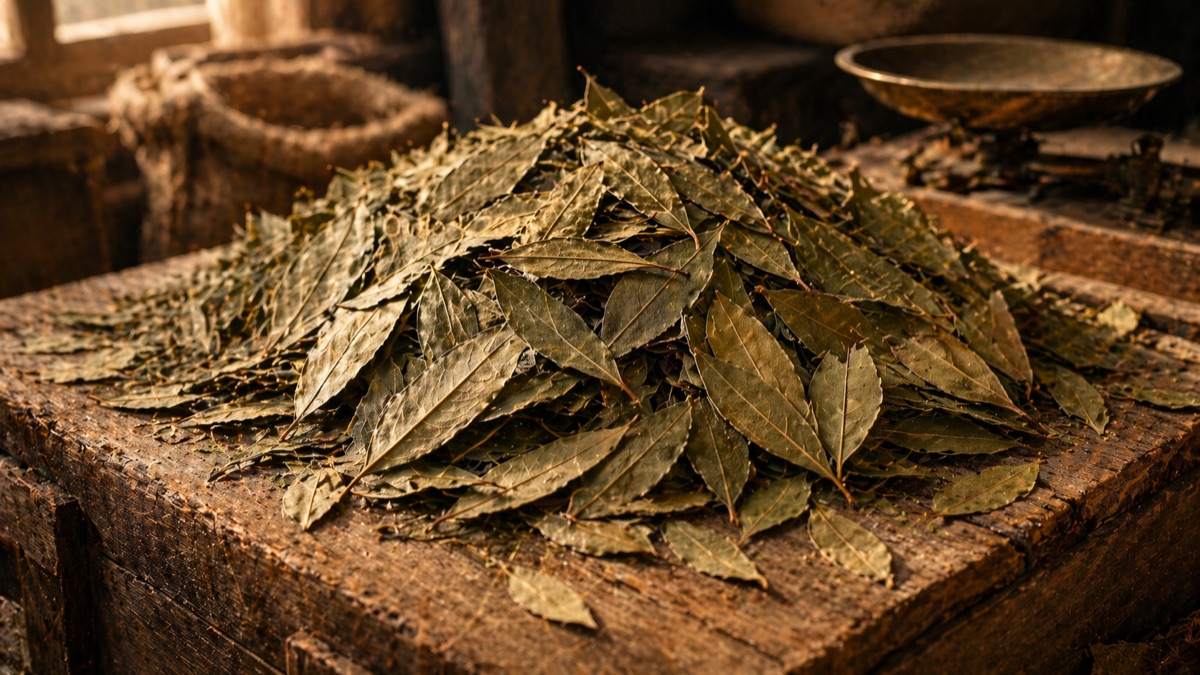
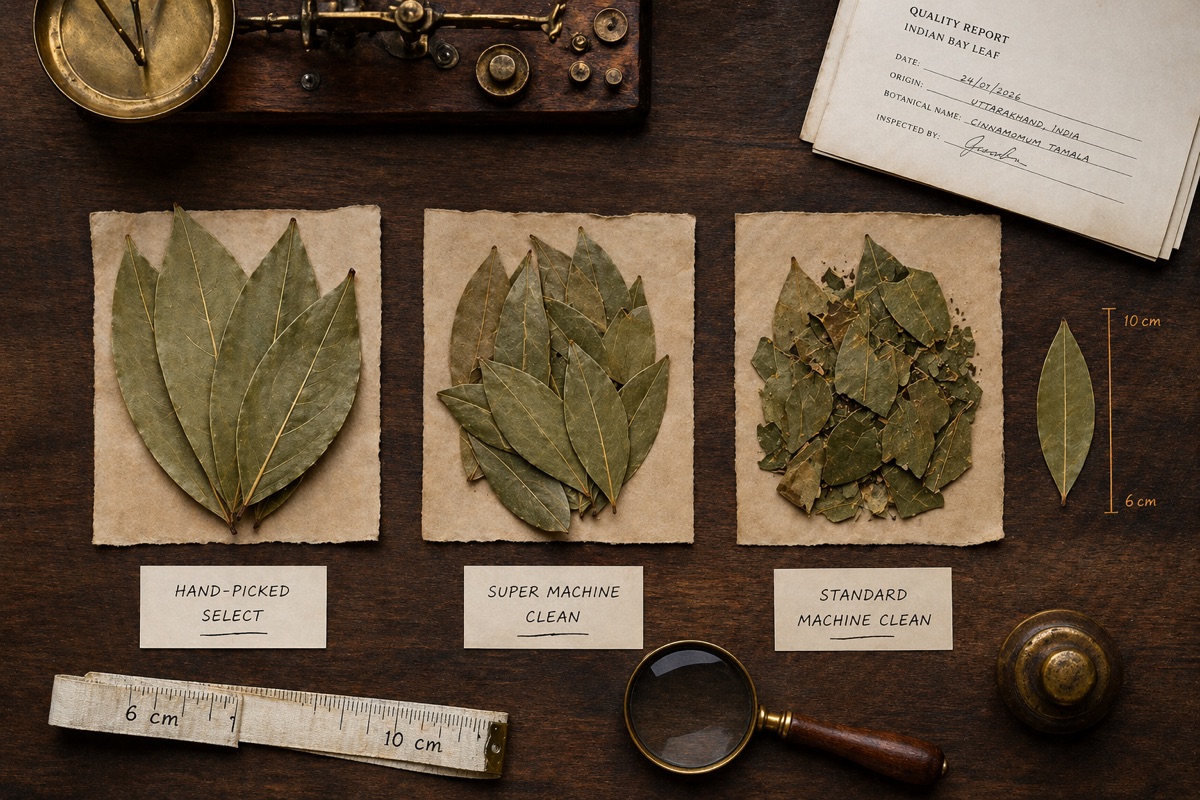
Indian tej patta grading is more disciplined than most first-time buyers assume. The ladder runs from standard machine clean at the base, to super machine clean in the middle, to hand-picked select at the premium end. Above that sits a small but rapidly growing tier: GI-tagged Uttarakhand sweet tej patta and certified organic grades.
Super machine clean — the workhorse of serious export trade — ships at $3,400–3,800/MT FOB. Specifications: less than 2% broken leaf, zero stems, moisture below 10%, ash content below 6%, and volatile oil content of 1.0–3.0% (the European Spice Association’s minimum threshold for fragrance and flavor viability). Standard machine clean grade moves at $2,200–2,800/MT FOB and serves volume buyers less concerned with visual uniformity.
Hand-picked select — whole leaves, 6–10 cm, uniform olive-green — commands premiums above the machine-clean tiers and is typically specified by premium spice brands and private-label buyers targeting shelf-visible packaging.
Color is a quality parameter most Indian suppliers underdeliver on. European buyers want consistent olive-green to light-brown tones. Traditional sun-drying, still widespread in smallholder sourcing, produces inconsistent oxidation and darker leaves that fail visual QC. Serious exporters have moved to controlled-environment drying and optical sorting — the gap between these two processing approaches is the single biggest determinant of whether a shipment commands premium pricing or gets rejected at origin.
The most underappreciated lever in Indian bay leaf premiumization: Uttarakhand’s 2016 GI (Geographical Indication) registration for sweet tej patta — the first medicinal plant GI awarded to the state. This protected-origin status is effectively an Indian equivalent of European PDO labeling, and luxury spice brands and Ayurvedic formulators are beginning to specify it by name.
When ordering Indian bay leaf for EU shelves, specify: maximum moisture 10%, ash content below 6%, volatile oil content minimum 1.0%, and broken leaf content below 2%. Request SGS or Bureau Veritas pre-shipment inspection on first orders. For GI-tagged or organic consignments, require the producer’s GI registration certificate or valid NPOP/EU Organic transaction certificate alongside the phytosanitary.
EU Demand Drivers and 2026 Market Outlook
Germany imports over 2,500 MT of bay leaves annually — serving as both a consumption market and a re-processing hub that routes cleaned product to France, the Netherlands, and the broader Nordic region. France and the Netherlands sit second and third in EU volume. The UK, post-Brexit, now operates as an independent demand node with its own phytosanitary regime.
The organic bay leaf segment is growing at approximately 20% annually across the EU, with certified Indian organic tej patta commanding FOB premiums of $4,500–5,200/MT. The broader demand engine is Europe’s cosmetics and wellness sector — the EU cosmetics industry is projected to reach $178.8 billion by 2026, and bay leaf essential oil (1.5–2.5% by weight, extracted from higher-grade leaves) is used in anti-dandruff formulations, aromatherapy products, and natural soap manufacturing. Ayurvedic-adjacent wellness brands are a second growth vector.
The real bottleneck is compliance, not supply. EU pesticide Maximum Residue Limit (MRL) regulations — enforced under Regulation (EC) No 396/2005 — are where most Indian bay leaf shipments fail. Chlorpyrifos, endosulfan residues, and heavy-metal contamination from traditional sun-drying on open surfaces are the three most common rejection triggers at EU ports. Exporters who cannot provide third-party residue certification (GC-MS/LC-MS from NABL or equivalent accredited labs) will increasingly find themselves locked out of premium EU channels.
For European procurement teams, the 2026 strategy brief is clear: move early, contract directly, verify documentation. Spot-market buying is losing ground to annual volume commitments with certified origin suppliers. Private-label and own-brand spice buyers are specifically seeking GI-tagged Uttarakhand origin and organic-certified consignments as differentiation levers for premium retail positioning.
Radiance Overseas supplies super machine clean, hand-picked select, GI-tagged Uttarakhand, and certified organic tej patta — with comprehensive phytosanitary documentation, pesticide residue analysis, and pre-shipment inspection available on request. Minimum order quantities start at 5 MT for trial orders.