India's Dehydrated Vegetable Export Landscape — The Verified Numbers
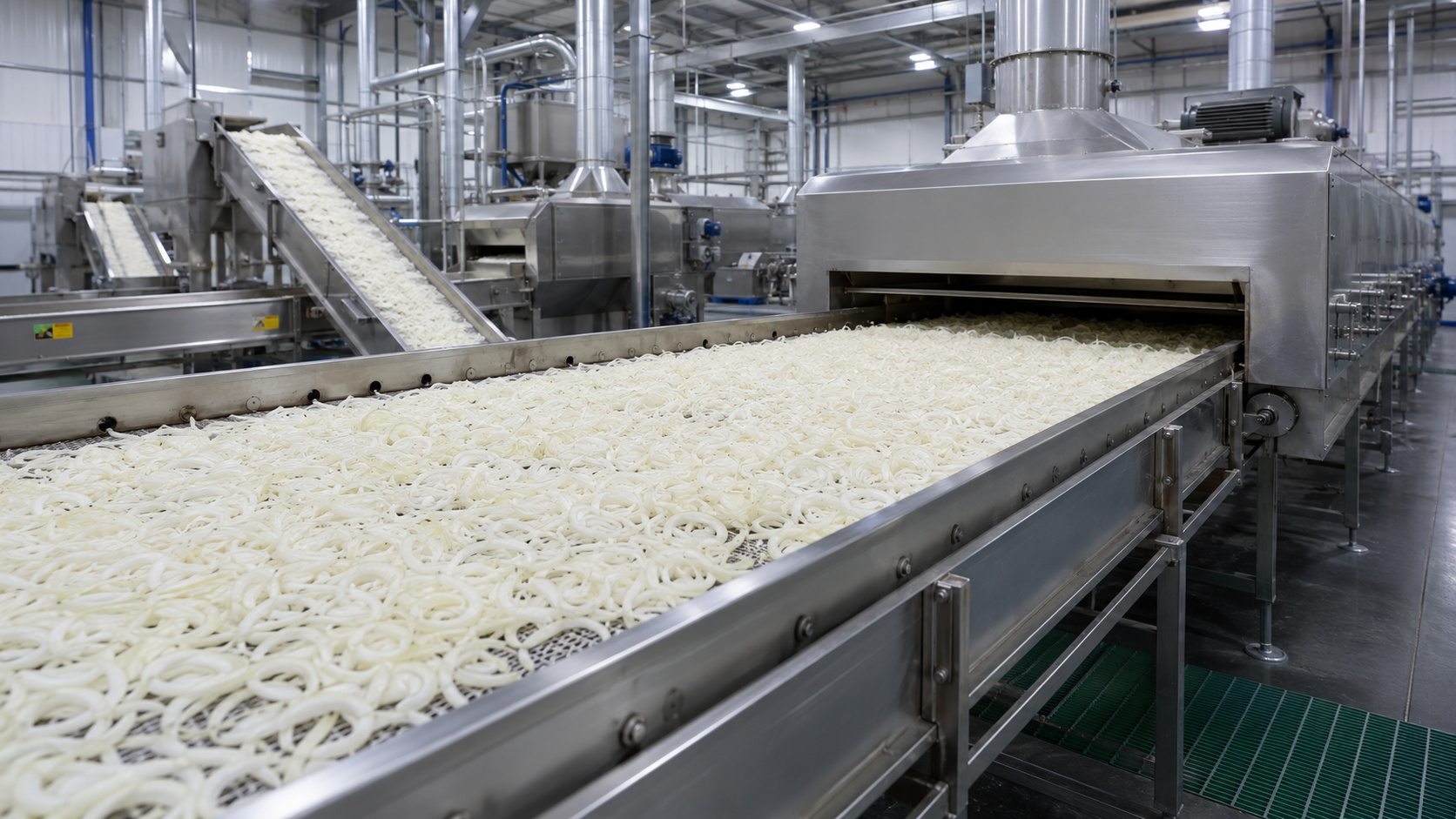
India is quietly one of the world's largest dehydrated vegetable processing hubs. Gujarat's Mahuva-Bhavnagar belt hosts ~120 dehydration plants producing roughly 80,000 tonnes of dehydrated onion powder and ~40,000 tonnes of dehydrated garlic powder annually — with ~90% of both exported. Mahuva primarily processes white onion, preferred for its lower water content, higher dry-matter yield, and lighter colour suited to premium food applications. Gujarat exported 83,452 tonnes of dehydrated white onion in FY 2023-24, a 67% growth driven by India's fresh-onion export ban redirecting volume into dehydration. Madhya Pradesh's Mandsaur-Neemuch belt is India's garlic heartland — black loamy soils and cool winters ideal for high-allicin bulb formation. Key buyer markets: USA (largest single destination), EU (largest regional bloc), UK, Canada, UAE, Saudi Arabia, Japan, Australia, and West Africa. But 2026 is the year EU compliance separates the serious exporters from the rest: since September 2020, EU authorities have flagged 525+ Indian food consignments through RASFF for ethylene oxide contamination — 87 with outright border rejections.
Product Range, FOB Prices, and EU Compliance Specifications
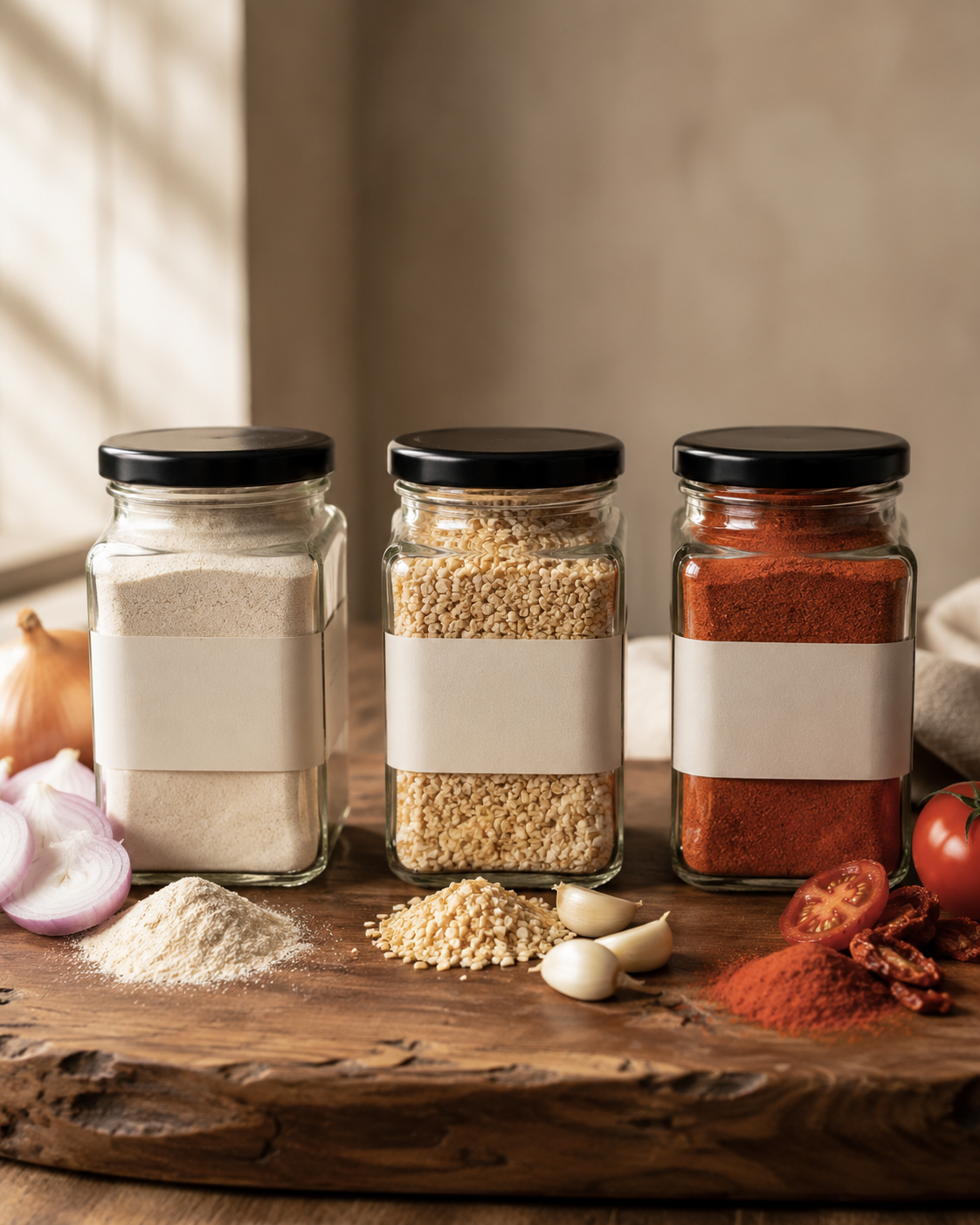
All price ranges below are indicative for mid-2026 — always request a current dated quotation. Dehydrated onion FOB Mundra/Kandla: flakes (5–10 mm) US$ 1,300–1,700/MT; minced (1–3 mm) US$ 1,400–1,800/MT; granules (0.5–1 mm) US$ 1,500–2,000/MT; powder (80–100 mesh) US$ 1,600–2,200/MT; toasted/roasted US$ 2,200–2,800/MT. Dehydrated garlic FOB: flakes US$ 2,800–3,500/MT; minced/chopped US$ 2,900–3,600/MT; granules US$ 3,000–3,700/MT; powder (80–120 mesh) US$ 3,200–4,000/MT. Other products: ginger powder US$ 2,200–2,800/MT; tomato powder (drum-dried) US$ 1,800–2,500/MT; spinach powder US$ 2,500–3,200/MT; kasuri methi powder US$ 3,000–4,000/MT; mixed vegetable flakes US$ 2,500–3,500/MT. Process distinction: hot-air drying (belt/tray dryer) is the standard low-cost method for industrial food manufacturing; freeze-drying (lyophilisation) preserves 95%+ of original colour, flavour, and nutrients but commands a 3–5× premium — specify the drying process explicitly on every PO or you will receive hot-air-dried by default. HS codes: 0712.20.00 (dehydrated onion); 0712.90.05 (dehydrated garlic); 0712.90.30 (other dried vegetables).
Before placing any EU-destined dehydrated vegetable order, confirm: (1) BRCGS Food Safety Grade A/AA or FSSC 22000 with your specific product category in the scope; (2) Pesticide multi-residue test per batch from a NABL or EU-recognised lab; (3) ETO test explicitly listed in the test scope — do not assume it is covered by a general pesticide screen; (4) Microbiology CoA per batch (Salmonella absent/25 g, E. coli absent/1 g, TPC ≤100,000 CFU/g); (5) For organic supply: valid NPOP Transaction Certificate plus a non-ETO steam sterilisation declaration. A serious Tier-1 exporter provides all of this without resistance.
Ethylene Oxide, RASFF Risk, and the Supplier-Tier Reality
Between September 2020 and April 2024, EU authorities flagged 527 Indian food products through RASFF — ETO detected in 525 of them, 87 consignments rejected at the border. ETO is a colourless sterilising gas — cheap and effective against Salmonella and E. coli — but classified as carcinogenic, mutagenic, and reprotoxic. The EU MRL is 0.1 mg/kg, enforced since 2020-21. Indian dehydrated vegetable processors span three tiers: Tier 1 (EU/US-compliant): BRCGS Grade A/AA or FSSC 22000, steam sterilisation only, in-house HPLC/GC-MS labs — premium of US$ 80–200/MT over Tier 3, worth every dollar. Tier 2 (FSSAI/HACCP certified): reliable for Middle East, parts of Asia, and Africa where ETO MRLs are not yet enforced. Tier 3 (uncertified): low headline price, inconsistent quality, no documentation — not suitable for any EU supply chain. The price gap between Tier 1 and Tier 3 is only 8–15% at the MT level. The regulatory and reputational gap is enormous. Procurement timing: onion processing peaks December–March (post kharif harvest); garlic processing peaks April–July (post rabi harvest). Forward contracting 3–6 months ahead delivers the best fresh-batch quality and competitive pricing.
How to Source EU-Compliant Dehydrated Vegetables Through Radiance Overseas
Radiance Overseas, headquartered in Indore, Madhya Pradesh — adjacent to the Mandsaur-Neemuch garlic belt — has been exporting certified Indian agro-products since 2011. We work exclusively with Tier-1 dehydration processors in Gujarat (Mahuva) and Madhya Pradesh to deliver EU/UK/US-compliant supply. What buyers receive: full product range (dehydrated white and pink onion in flakes/minced/granules/powder/toasted; dehydrated garlic flakes/granules/powder; ginger powder; tomato powder; spinach and leafy-greens powders; mixed vegetable flakes); Tier-1 partnerships only — BRCGS Grade A/AA or FSSC 22000 certified; batch-specific CoA covering moisture, pesticide multi-residue (incl. ETO), microbiology, and heavy metals; APEDA, FSSAI, USDA-NOP, EU Organic, and ISO 22000 certifications on file; Halal and Kosher available on request; non-ETO steam sterilisation available on declaration; 25 kg multi-layer kraft PE-liner bags; FCL via Mundra, Kandla, or Nhava Sheva; LCL pilot orders from 100 kg MOQ under our private-label programme. Contact: 📞 India: +91-95849-49494 | +91-94068-00327 | 📞 USA: +1-469-544-9746 | ✉️ info@radianceoverseas.com | 🌐 www.radianceoverseas.com
Frequently Asked Questions
What is the difference between dehydrated and freeze-dried vegetables?
Dehydrated (hot-air-dried) vegetables are processed at 50–70°C — economical, shelf-stable, the global default for industrial food manufacturing. Freeze-dried vegetables are processed below freezing under vacuum, preserving 95%+ of original colour, flavour, and nutrients — at a 3–5× price premium. Specify the process on every PO.
Are Indian dehydrated vegetables ETO-free?
Tier-1 EU-compliant exporters use steam sterilisation only and provide non-ETO declarations per shipment. Always require a written non-ETO declaration and a batch-specific ETO test result from a NABL-accredited lab for any EU-destined order.
What is the HS code for dehydrated onion and garlic from India?
Dehydrated onion: 0712.20.00. Dehydrated garlic: 0712.90.05 (some classifications use 0712.90.10). Confirm with your destination-country customs broker before shipment.
What certifications should I require?
For EU/UK: BRCGS Food Safety Grade A/AA or FSSC 22000 with your product category in scope; pesticide test to EU MRL; ETO test certificate; microbiology CoA per batch. For US: FDA registration and FSMA compliance. For organic: NPOP plus destination-market organic equivalent.
When is the best time to contract?
Onion: forward contract September–November for the December–March processing peak. Garlic: forward contract January–March for the April–July processing peak. Spot procurement after the processing window typically carries a premium.
What is the shelf life of dehydrated vegetables?
18–24 months in sealed multi-layer kraft + PE-liner packaging at under 25°C and under 60% relative humidity. Nitrogen-flushed powder formats can extend to 36 months.
What is the minimum order quantity?
One 20-foot container (~16–18 MT) for full FCL orders. Radiance Overseas accepts LCL pilot orders from 100 kg for private-label and sample programmes.