India's Place in the Global Walnut Market — The Honest Picture
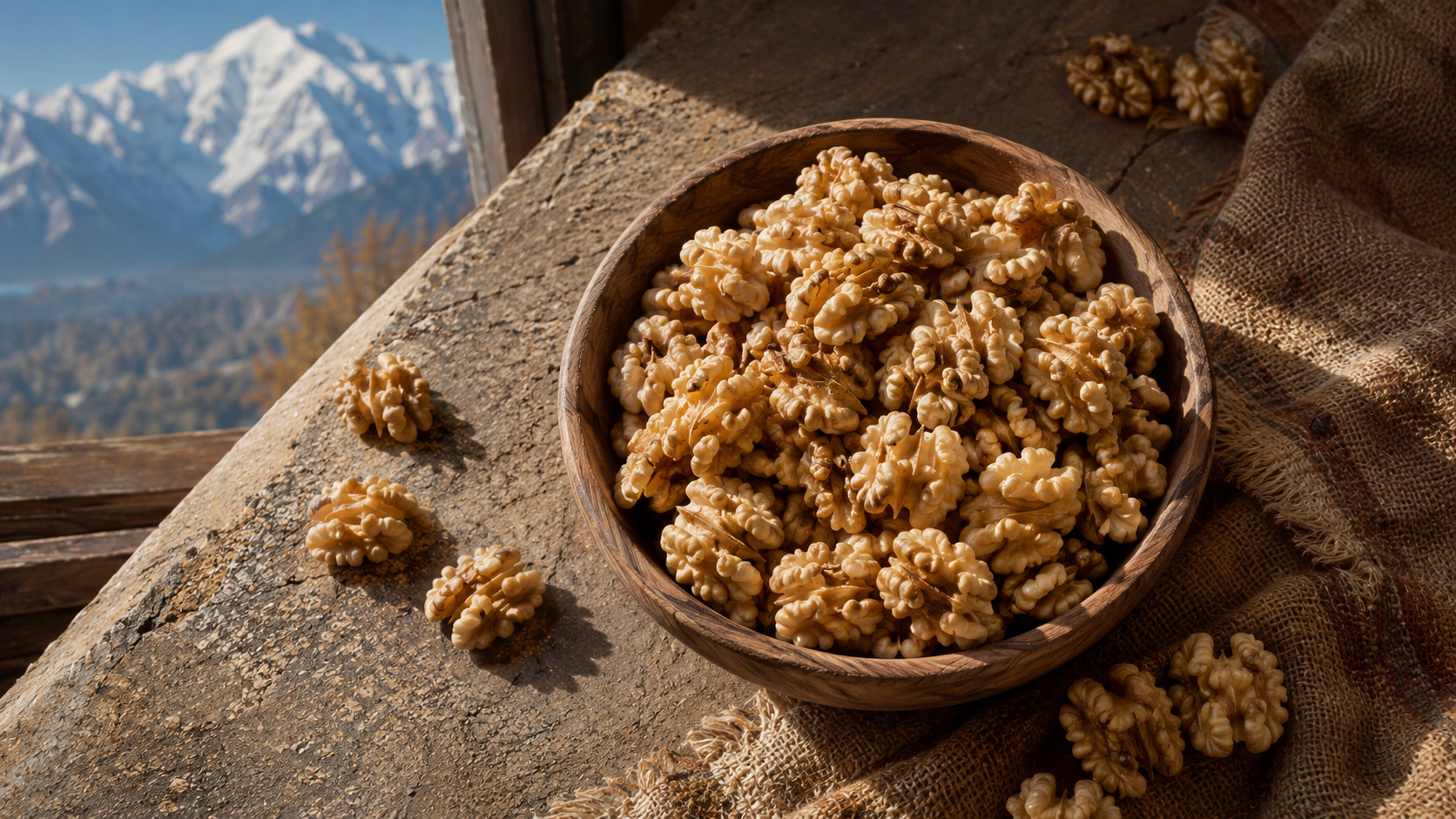
India is a small but distinctive exporter in a global walnut trade dominated by China, the USA, and Chile. Per the USDA FAS Tree Nuts Annual (October 2025), India's walnut exports for MY 2025-26 are forecast at approximately 2,500 MT — down from 3,200 MT the prior year — with over 95% shipped as shelled kernels in vacuum packs. Critically, India is a net importer of walnuts (~75,000 MT/year, mainly from California and Chile), which means the export business is built entirely on quality differentiation, not volume. Kashmir walnuts — representing ~90% of India's production — have distinctive light-cream kernel colour, lower bitterness, and a fresh aromatic profile that appeals to premium confectionery and gifting markets in the Middle East, South Asia, and the EU. Orchards span Kupwara, Baramulla, Anantnag, Shopian, Budgam, and Pulwama districts. J&K is officially designated an Agri Export Zone for Walnuts.
Kashmir Walnut Grades and Export Quality Benchmarks
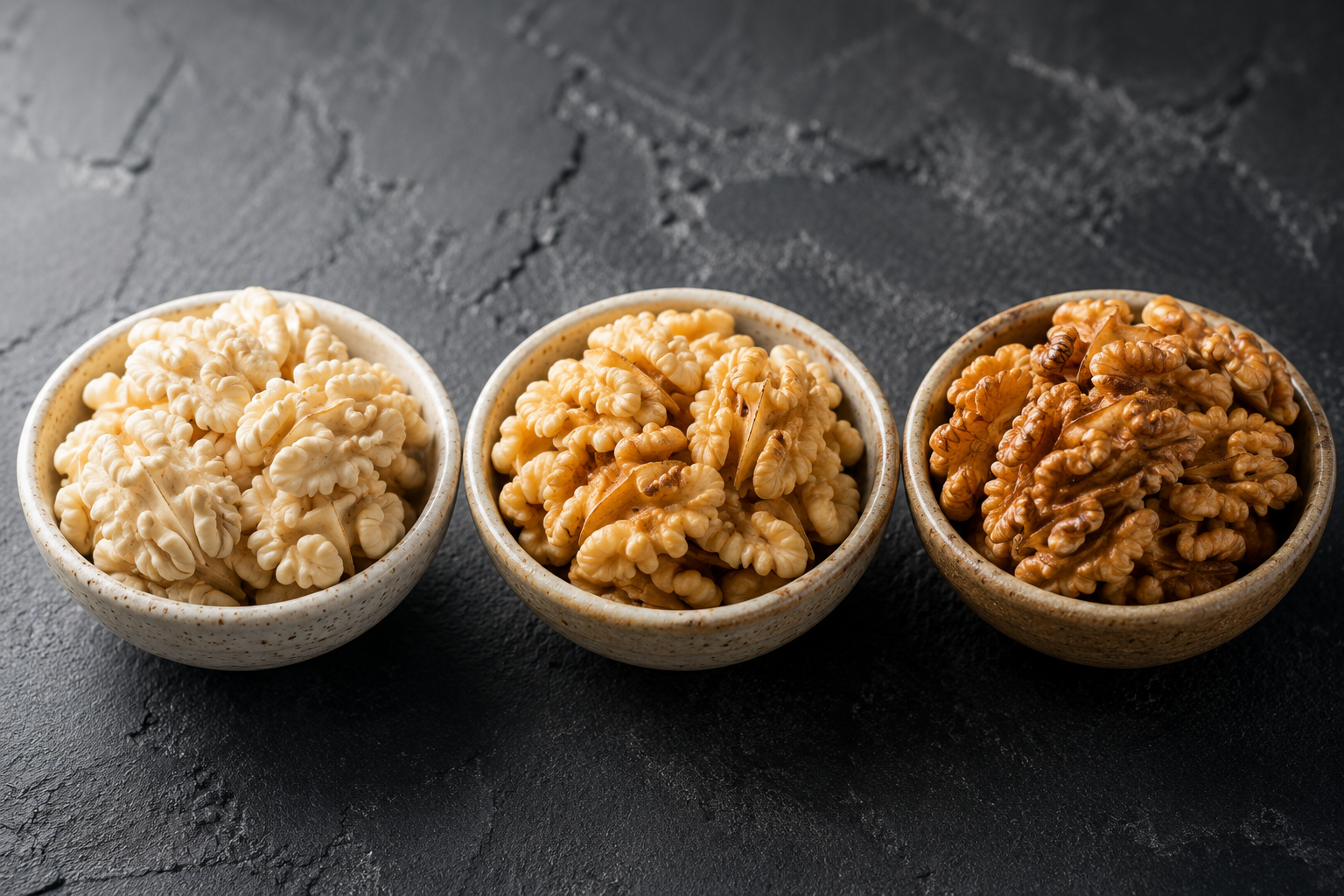
The export trade is grade-sensitive — specifying only 'Kashmir walnut' without a written spec exposes buyers to colour drift and rejection risk at destination. Kernel colour grades: Extra Light Halves (pale cream, ≥80% halves — top tier for premium gifting, baklava, mithai, and gourmet baking); Light Halves (pale to light yellow — the export workhorse); Light Amber Halves (acceptable colour drift, widely used in industrial baking and snacks); Amber Halves / Pieces (for grinding, walnut oil, or filler). In-shell grades: Kagazi / paper-shell is the highest-premium in-shell grade; Wonth / hard-shell is mainly for local consumption. Critical specifications to write into every PO: moisture ≤ 5% (kernels), FFA ≤ 1.0%, peroxide value ≤ 5 meq O2/kg, aflatoxin B1 ≤ 2 µg/kg and total aflatoxins ≤ 4 µg/kg (EU Regulation 2023/915), Salmonella absent in 25 g, foreign matter ≤ 0.5%. Aflatoxin compliance is the single biggest trade barrier — EU buyers reject shipments at port if limits are exceeded. Pre-shipment testing at NABL-accredited Indian laboratories is now standard practice. HS codes: 0802.32.00 (shelled walnuts); 0802.31.00 (in-shell walnuts).
When sourcing Kashmir light halves: (1) request a current-season sample — avoid old-crop carry-over stock; (2) require an NABL aflatoxin test report dated within 30 days of shipment; (3) specify vacuum-sealed 10 kg cartons inside corrugated master cases; (4) write the colour tier explicitly — Extra Light / Light / Light Amber — in the PO. 'Kashmir light halves' alone is not a complete specification.
Pricing, Buyer Markets, and How Kashmir Competes
Walnut prices move sharply with each crop year — treat all figures as directional only and always request a current, dated quotation. As of mid-2026: Kashmir light-to-extra-light halves FOB: indicative US$ 8–12/kg for genuine export-quality grade. Kashmir trades above California Chandler for the premium segment — the premium reflects colour, taste, and origin positioning. California Chandler shelled wholesale: ~US$ 4.30–5.50/kg (USDA NASS). Chilean walnut FOB: ~US$ 5–7/kg for halves. Key buyer markets (APEDA MY 2024-25): UAE, Turkey, Iraq, Singapore, Algeria, Qatar, Bhutan, Kuwait — the Middle East is India's natural geography, driven by diaspora demand and Ramadan gifting cycles. Kashmir wins on: colour (light-cream kernels), taste (lower bitterness), and premium retail/gifting positioning; the September–October harvest is counter-seasonal to California. California and Chile win on: uniform large-half sizing, volume reliability for industrial bakeries, and lower per-kg cost at industrial grades. For most international buyers the right strategy is a dual-origin programme — California or Chile for industrial volume; Kashmir light halves for the premium SKU on the same shelf.
How to Source Kashmir Walnuts Through Radiance Overseas
Radiance Overseas, based in Indore, Madhya Pradesh, has been exporting certified Indian agro-products since 2011 — including premium dry fruits and nuts to clients across the USA, Canada, EU, UK, GCC, ASEAN, and Australia. What Kashmir walnut buyers receive: direct sourcing from established Kashmir processors with full chain-of-custody traceability; grade-specific supply (Extra Light, Light, Light Amber, Amber Halves, and in-shell Kagazi); compliance documentation including NABL aflatoxin reports, CoA, Certificate of Origin, and Phytosanitary Certificate; APEDA, FSSAI, USDA-NOP, EU Organic, and India Organic certifications on file; Halal and Kosher available on request; vacuum-sealed 10 kg or 11.34 kg cartons, palletised and customer-branded on demand; shipping via reefer container FCL/LCL, FOB Nhava Sheva or Mundra, CIF to most destinations; flexible MOQ with pilot shipments accepted under our private-label programme. Contact: 📞 +1 469 544 9746 | ✉️ info@radianceoverseas.com | 🌐 www.radianceoverseas.com
Frequently Asked Questions
How much walnut does India actually export?
USDA FAS forecasts Indian walnut exports for MY 2025-26 at ~2,500 MT, down from 3,200 MT the prior year. India is a quality-segment exporter and a net importer of ~75,000 MT/year from California and Chile.
Are Kashmir walnuts better than California Chandler?
Application-dependent. Kashmir walnuts have paler colour and milder taste — preferred for premium gifting, mithai, baklava, and gourmet retail. California Chandler is preferred for industrial uniformity and supply predictability. Most sophisticated buyers run both.
What is the EU aflatoxin limit for walnuts?
Under EU Regulation 2023/915: aflatoxin B1 ≤ 2 µg/kg, total aflatoxins ≤ 4 µg/kg for direct human consumption. Always require an NABL-tested batch certificate before shipping to EU destinations.
What HS code is used for walnut exports from India?
0802.32.00 for shelled walnuts; 0802.31.00 for in-shell walnuts. Specify the correct HS code on every invoice to avoid customs delays.
When is the Kashmir walnut harvest?
September–October. New-crop kernel availability for export begins from November. Request current-crop samples explicitly to avoid old-stock substitution.
What is the minimum order quantity?
One 20-foot reefer container (~12–14 MT vacuum-packed kernels) for full container loads; LCL pilot shipments available through Radiance Overseas's private-label programme.