India's Role in the 2026 Global Black Pepper Market
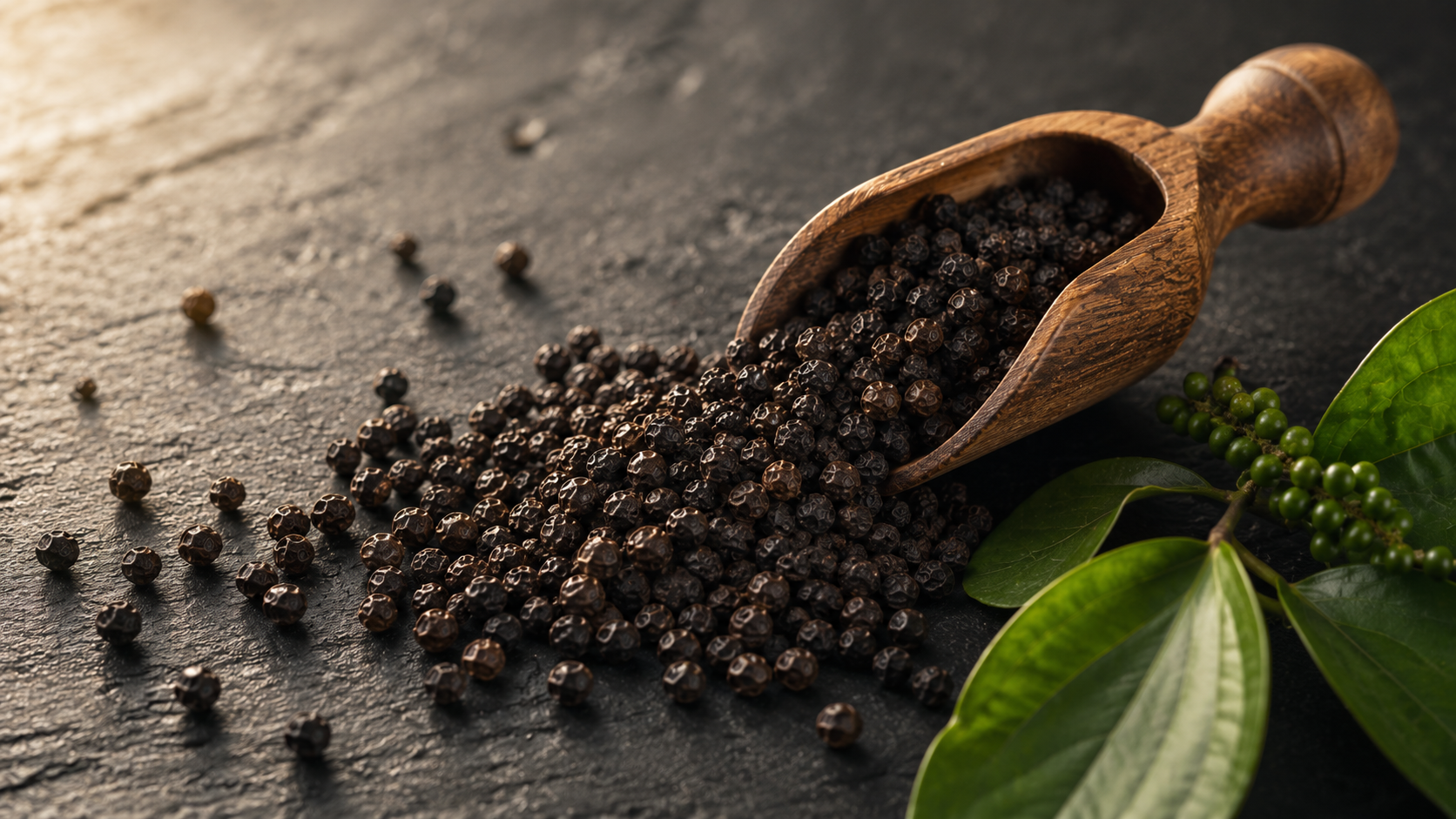
India is no longer the volume leader in global black pepper — Vietnam (~35–40% of production), Brazil (~15–20%), and Indonesia (~10–15%) all produce more. But India remains the undisputed quality benchmark, and 2026 is one of the most consequential years for the pepper trade in a decade. El Niño-driven drought in Vietnam's Central Highlands and under-investment following the 2018 price collapse have pushed global supply to its tightest balance in years. India produces approximately 8–10% of global output — but strong domestic consumption absorbs most production, making exports a concentrated premium-segment play. Kerala accounts for ~85–90% of India's black pepper output, across Idukki, Wayanad, Kannur (Thalassery / Tellicherry), Kasaragod, and Palakkad districts; Karnataka (Coorg, Chikkamagaluru) contributes a further 8–12%. Note on the name: 'Tellicherry' derives from Thalassery, the historic Kannur port district — but today it denotes a grade specification, not a place of origin: the largest, boldest, most fragrant berries in any given crop.
The Grade Hierarchy: TGSEB, TGEB, MG1, MG2, and White Pepper
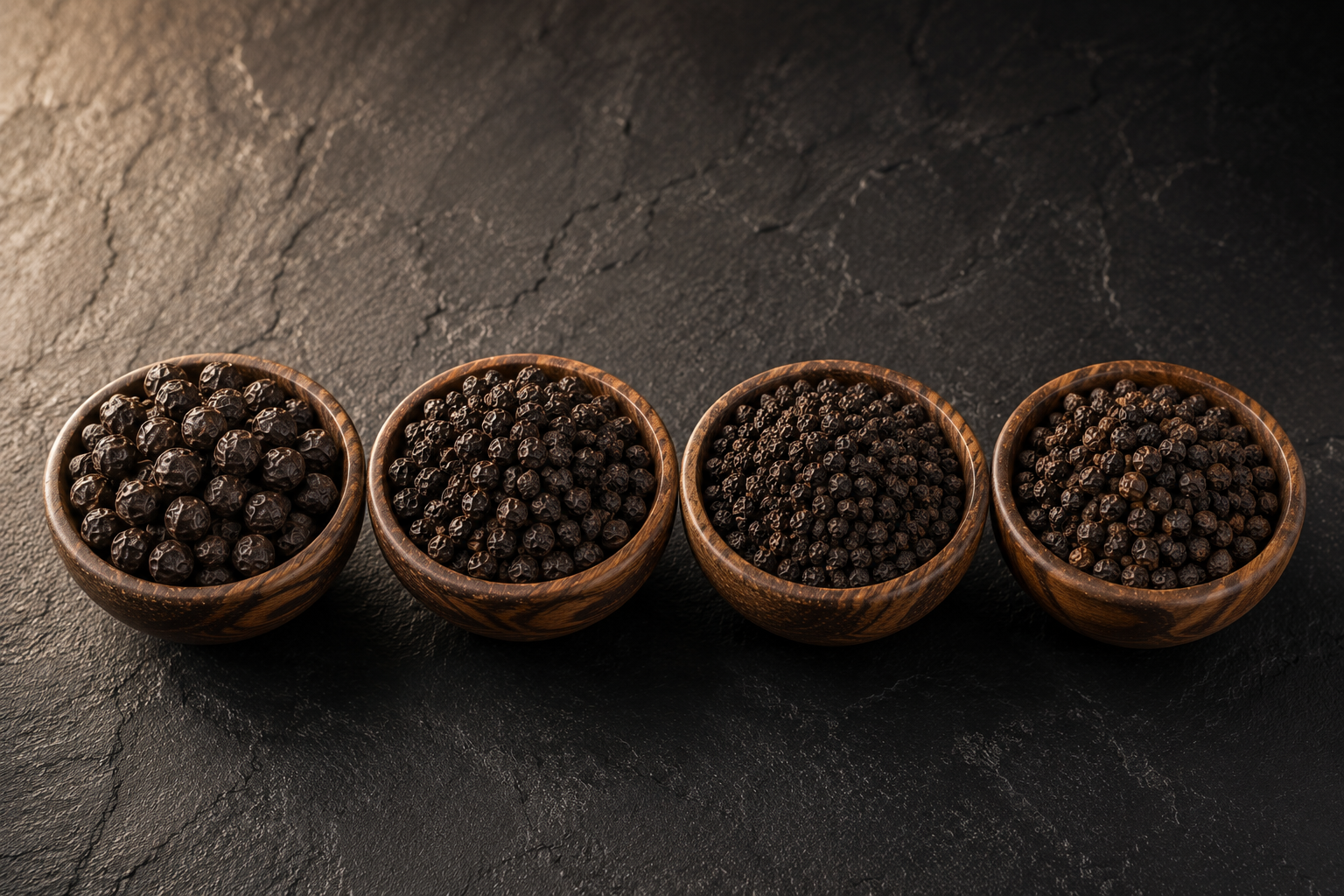
Indian black pepper grades are defined by screen size, bulk density, garbling quality, moisture, and visual defects. Specifying the grade in writing is the single most important step in a procurement order. TGSEB (Tellicherry Garbled Special Extra Bold): ≥5.5 mm screen, ~570–580 g/litre bulk density, highest garbling cleanliness, piperine 4–7% — the apex grade for premium gourmet retail, single-origin spice brands, and nutraceutical/pharmaceutical extractions. TGEB (Tellicherry Garbled Extra Bold): ≥4.75 mm screen, same provenance as TGSEB, slightly smaller berry — premium foodservice and branded ground pepper. MG1 (Malabar Garbled Grade 1): ≥4.25 mm screen, ~550 g/litre, piperine 3–5% — the standard export grade for food manufacturers and spice blenders. MG2 (Malabar Garbled Grade 2): 3.0–4.25 mm, ~520 g/litre — value retail and oleoresin extraction. Ungarbled / FAQ: mixed screen, higher extraneous matter — oleoresin extraction and low-spec blending. Malabar White Pepper: ripe red berries water-retted to remove the outer pericarp, then dried — labour-intensive, premium FOB US$ 12,000–16,500/MT, used in light-coloured sauces and Asian cuisines. Key export specs: moisture ≤ 11%, volatile oil ≥ 2.0 ml/100g (TGSEB/TGEB), Salmonella absent in 25 g. HS codes: 0904.11.30 (whole black pepper); 0904.12.00 (crushed/ground); 3301.90.13 (pepper oils/oleoresins).
Require batch-specific CoA covering moisture, extraneous matter, ash, volatile oil, piperine (GC analysis), pesticide residues (EU Regulation 396/2005 for EU buyers; ASTA cleanliness specs for US buyers), and microbiology (Salmonella, E. coli, TPC). For EU and Japan shipments, confirm steam sterilisation / ETO-free treatment status in writing. Screen-size distribution reports (% retained on 5.5 mm / 4.75 mm / 4.25 mm sieves) should accompany every TGSEB / TGEB / MG1 shipment.
2026 FOB Price Benchmarks and the Vietnam Supply Context
The supply squeeze traces to 2018, when global pepper prices crashed and Vietnamese farmers stopped investing in new plantings. Pepper vines take 3–4 years to reach productive maturity — so the 2018 under-investment, compounded by El Niño-driven drought in Vietnam's Central Highlands (Dak Lak and Gia Lai provinces) in 2024–25, is now driving global tightness. Indicative FOB prices at Cochin as of mid-2026 (always request a current, dated quotation): TGSEB US$ 9,000–11,000/MT; TGEB US$ 8,200–10,000/MT; MG1 US$ 7,500–9,000/MT; MG2 US$ 7,000–8,200/MT; White Pepper US$ 12,000–16,500/MT. For comparison: Vietnam 500 g/l ASTA FOB HCMC ~US$ 6,800–7,500/MT; Brazil ASTA FOB ~US$ 6,500–7,200/MT. Key buyer markets: USA (largest single buyer), UK, Germany, Netherlands, Canada, UAE, Saudi Arabia, Japan, Australia. Smart 2026 sourcing strategy: a dual-origin model — Indian premium grades (TGSEB, TGEB, MG1) anchor quality-sensitive branded SKUs and pharma/nutraceutical applications; Vietnamese or Brazilian grades supply cost-sensitive commodity blending where volume and price predictability matter more. This bifurcates risk across weather and tariff exposure.
How to Source Indian Black Pepper Through Radiance Overseas
Radiance Overseas, headquartered in Indore (Madhya Pradesh), is an APEDA-registered exporter since 2011 — shipping to the USA, EU, UK, GCC, ASEAN, Australia, and Africa. We work with vetted Kerala and Karnataka processors to source the full premium black pepper grade ladder. What buyers receive: full grade range (TGSEB, TGEB, MG1, MG2, ungarbled, and Malabar white pepper) to written specification; batch-specific CoA covering moisture, extraneous matter, ash, volatile oil, piperine (GC), pesticide residues, and microbiology; APEDA, FSSAI, Spices Board, USDA-NOP, and EU Organic certifications on file; Halal and Kosher available on request; steam sterilisation / ETO-free treatment for EU and Japan shipments; food-grade jute or PP bags in 25 kg or 50 kg, palletised; vacuum-packed retail SKUs for private-label customers; FCL via Cochin, Nhava Sheva, or Mundra; LCL for pilot orders; flexible MOQ under our private-label programme. Contact: 📞 India: +91-95849-49494 | +91-94068-00327 | 📞 USA: +1-469-544-9746 | ✉️ info@radianceoverseas.com | 🌐 www.radianceoverseas.com
Frequently Asked Questions
What is the difference between Tellicherry and Malabar pepper?
Both come from Kerala, India. The difference is grade specification — Tellicherry refers to the largest, boldest garbled berries (≥4.75 mm screen); Malabar is the broader export classification by berry size and garbling quality. All Tellicherry is Malabar; not all Malabar is Tellicherry.
What is TGSEB and why does it cost more?
TGSEB (Tellicherry Garbled Special Extra Bold) requires berries ≥5.5 mm screen, the highest bulk density, and the cleanest garbling. Only a small fraction of any given Kerala crop qualifies — which is why it commands a US$ 1,500–3,000/MT premium over MG1.
How does Indian black pepper compare with Vietnamese pepper on piperine?
Premium Indian grades (TGSEB, TGEB) typically test 4–7% piperine. Standard Vietnamese 500 g/l grade tests 3–5%. Specify piperine in your PO and require GC verification on every batch.
What is the HS code for Indian black pepper exports?
0904.11.30 for whole black pepper; 0904.12.00 for crushed or ground pepper; 3301.90.13 for pepper oils and oleoresins.
Does Indian black pepper meet EU pesticide MRL standards?
Reputable exporters using NABL-accredited labs and Spices Board protocols consistently meet EU Regulation 396/2005 MRLs. Always require batch-specific residue testing and confirm steam-sterilisation / ETO-free treatment status for EU and Japan shipments.
When is the Indian black pepper harvest?
December–February in Kerala and Karnataka, with peak export-quality availability from March onward. Forward contracting in February–April typically gives buyers the best combination of fresh-crop quality and competitive FOB pricing.
What is the minimum order quantity?
Standard MOQ is one 20-foot container (~15–17 MT in jute bags or ~18 MT palletised). LCL pilot orders available under Radiance Overseas's private-label programme.