Indian Coffee Has Finally Shed Its "Filler" Reputation
Indian coffee has finally shed its reputation as a "filler" origin. As of FY 2025–26, India's coffee exports have hit a record $1.8 billion, with approximately 450,000 MT moving through our ports. While Robusta still does the heavy lifting for Italian espresso blenders, the real story for 2026 is the "Premium Grade Revolution" occurring in the Arabica belts of Araku and Coorg.
For years, Indian Arabica was the industry's best-kept secret — a reliable, low-acid utility bean. That changed when supply disruptions in Vietnam and South America forced roasters to look elsewhere. Today, Indian Robusta is holding its own at $3,200–$3,800/MT FOB, while specialty Arabica lots are commanding premiums as high as $6,200/MT.
Origin Deep-Dive: Where the Value Lies in 2026
If you are sourcing for a specialty program, the Mysore/Coorg binary is no longer enough. Here is the current 2026 landscape:
Araku Valley
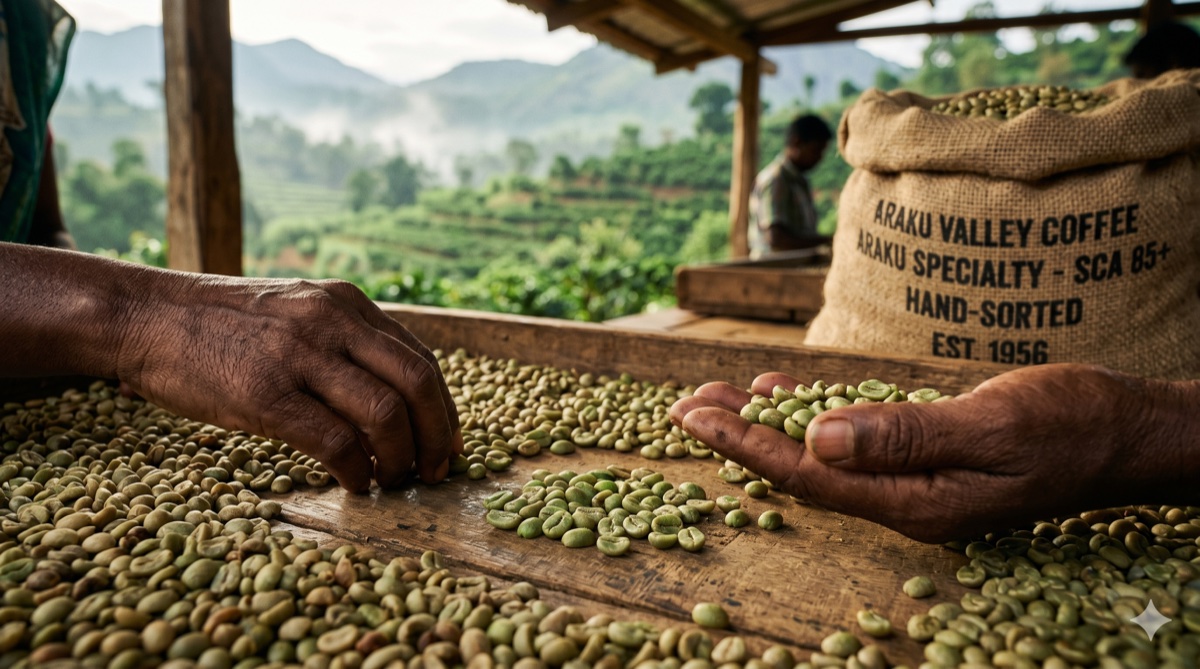
This tribal-grown origin is the breakout star of 2026. Grown at 900–1,100m, these lots are hitting SCA scores of 83–87. Expect citrus and floral notes that rival high-end Ethiopians, but with a unique Indian sweetness. Araku's tribal cooperative model also gives buyers a compelling sustainability and provenance narrative for premium retail programs.
Coorg (Kodagu)
This is your volume-specialty play. Coorg Arabica delivers a clean, fruity profile that European roasters are increasingly using as a single-origin pour-over. It offers consistent quality at scale — rare in the specialty tier — making it the practical choice for roasters building a permanent India single-origin SKU.
Monsoon Malabar
A divisive but high-demand process where beans are exposed to monsoon winds, swelling in size and losing nearly all acidity. It remains a staple for the German and Austrian markets, trading at a $600–$900/MT premium over standard Arabica. The distinctive low-acid, full-body profile makes it irreplaceable for certain espresso blends and the growing decaf-adjacent health-conscious consumer segment.
The Shift: From Blenders to Single Origins
The structural change in how global roasters are positioning Indian coffee is not cyclical — it is permanent. Two forces are driving it:
Supply disruption as discovery engine: When Vietnamese Robusta output tightened and South American Arabica faced weather-related crop stress, buyers were forced to evaluate Indian lots seriously for the first time. Many found the quality substantially above expectations. Those buyers did not return to ignoring India when supply normalised.
The specialty consumer's appetite for new origins: The third-wave coffee consumer in London, Amsterdam, and New York has already worked through the canonical Ethiopian, Colombian, and Kenyan single-origin rotations. India — particularly Araku — offers genuine differentiation: the tribal farming story, the altitude, the unique processing approach. For roasters building a specialty program, India is now a narrative asset, not just a supply hedge.
The practical implication: specialty Arabica allocation from Araku and premium Coorg estates is finite and increasingly contested between European specialty roasters. Buyers who establish direct-exporter relationships now — before the 2026–27 harvest cycle locks allocation — will hold a material advantage.
Insist on the Coffee Board of India Form CT-1. This isn't just paperwork — it's your only guarantee against re-exported, non-Indian beans being passed off as premium Coorg or Araku. CT-1 provides estate-level origin traceability, variety declaration, and Coffee Board registration confirmation. At Radiance, we provide CT-1 documentation and estate-level traceability as standard on every shipment. Any exporter unable to provide CT-1 for "Indian specialty" coffee should be treated as a red flag.
Frequently Asked Questions
What is the FOB price of Indian specialty Arabica coffee in 2026?
Specialty Arabica from premium Indian origins commands significant premiums in 2026. Top Araku Valley lots scoring 85+ SCA are reaching up to $6,200/MT FOB. Standard Indian Robusta trades at $3,200–$3,800/MT. Monsoon Malabar carries a $600–$900/MT premium over standard Arabica. Prices vary significantly by lot, SCA score, processing method, and organic certification status.
What makes Araku Valley coffee special and how does it compare to Ethiopian Arabica?
Araku Valley Arabica is grown at 900–1,100m by tribal cooperatives in Andhra Pradesh. Lots regularly achieve SCA scores of 83–87, with citrus and floral notes comparable to high-end Ethiopians but with a distinctive Indian sweetness. The tribal farming narrative, altitude, and hand-sorting process give buyers a compelling provenance story for specialty retail. Unlike Ethiopian lots, Araku supply is still undiscovered by most Western roasters — allocation is limited and increasingly contested.
What is Monsoon Malabar coffee and which markets buy it?
Monsoon Malabar is a unique Indian processing method where green Arabica beans are exposed to monsoon winds on open warehouses in Mangalore and Kozhikode, causing them to swell and lose nearly all acidity. The result is a full-bodied, low-acid, distinctively musty-sweet cup. It is a staple for German and Austrian espresso blenders and commands a $600–$900/MT premium over standard Arabica. It is also growing in popularity with specialty roasters seeking unusual single-origin profiles.
What is Coffee Board of India Form CT-1 and why is it essential?
Form CT-1 is the Coffee Board of India's official export documentation that provides estate-level traceability, variety declaration, and origin authentication for Indian coffee. It is the only reliable guarantee that "Indian specialty coffee" is genuinely Indian-grown and not re-exported beans from another origin. Always insist on CT-1 from any Indian coffee exporter — its absence is a significant red flag for origin fraud in the specialty segment.
How does Indian Robusta compare to Vietnamese Robusta for espresso blending?
Indian Robusta — primarily from Karnataka's Chikmagalur and Coorg regions — is a well-established alternative to Vietnamese Robusta for Italian and European espresso blenders. Indian Robusta typically offers a cleaner cup profile, lower defect rates, and full Coffee Board traceability. With Vietnamese supply tightening due to weather stress, Indian Robusta at $3,200–$3,800/MT FOB is holding its position as a reliable, quality-consistent blend component.